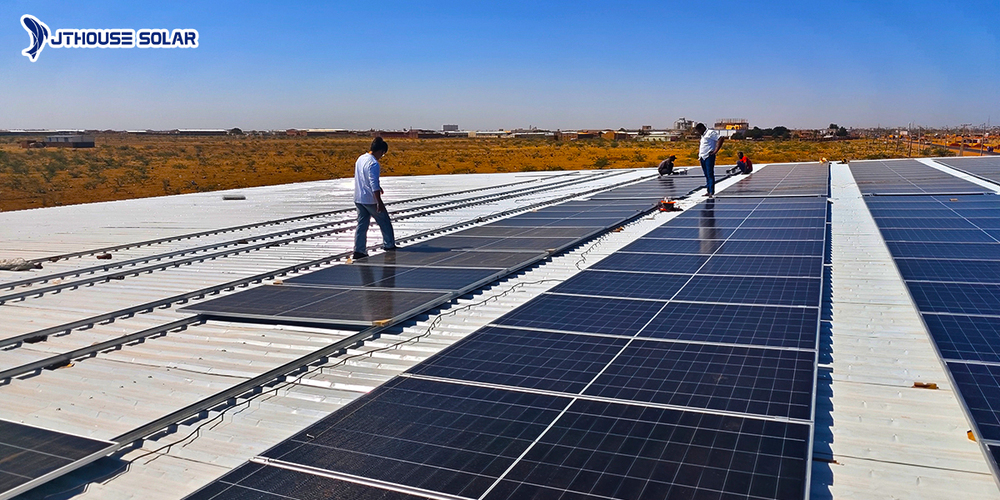
Africa Solar System Project: Stable Power for an African Factory LineIssuing time:2026-09-07 15:34 JTHouse Solar recently delivered a hybrid solar power system for a factory production line in Africa. The project combines a 365 kW rooftop PV array, a 320kW Deye hybrid inverter and a 212kWh Deye lithium battery, generating about 2,000kWh every day — twice the factory’s 1,000 kWh daily consumption. The result is a stable power supply with no production interruption, a lower initial investment and a shorter payback period. |

| Component | Specification | Role |
| PV modules | 365kW rooftop array | Main power generation |
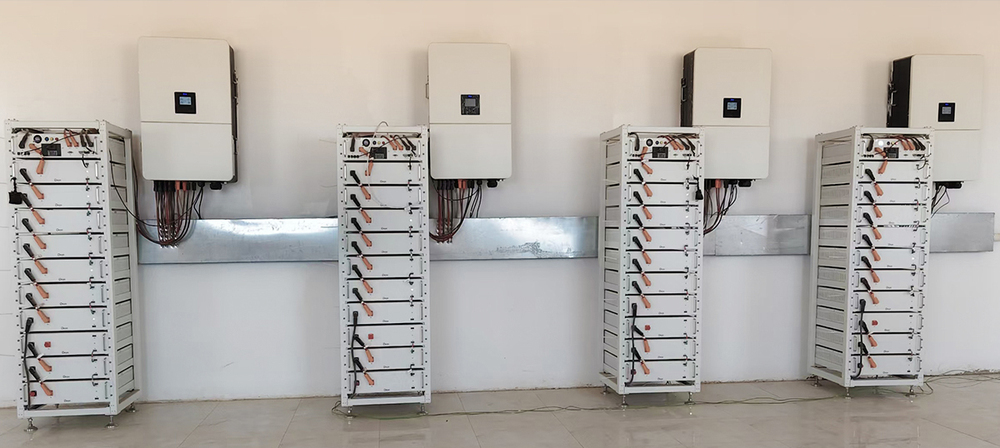
| Hybrid inverter | 320kW Deye inverter | Converts & manages energy flow |
| Battery storage | 212 kWh Deye LiFePO4 battery | Peak shaving & backup |
| Daily output | 2,000kWh generated / 1,000kWh used | 2× factory demand |
The challenge
Factories in Africa often face unstable grid power — voltage fluctuation, blackouts and load-shedding can stop a production line at any moment. For this customer, every interruption meant lost output, delayed orders and rising costs. They needed a power supply they could rely on around the clock, without paying for an oversized energy storage system.
The solution: more PV, less battery
Instead of oversizing the battery, JTHouse Solar designed a “more PV, less battery” configuration. A large 365 kW PV array captures maximum sunlight during the day to power the production line directly while charging the 212 kWh Deye battery at the same time. The 320 kW Deye hybrid inverter manages the energy flow intelligently, switching between PV, battery and grid automatically.
Strong African sunshine → the PV array alone can fully cover the daily 1,000 kWh load
Surplus daytime energy charges the battery and covers the evening peak
A smaller battery means a lower upfront investment
Higher solar self-consumption shortens the return period
The effect
Stable, uninterrupted power for the factory production line
Production stops caused by grid failure are eliminated
Energy cost is significantly reduced versus grid dependence
The optimized PV / battery ratio lowers cost and shortens the return on investment
Frequently asked questions
1. Why did this factory choose more PV and less battery?
Because its 1,000 kWh/day demand can be fully covered by sunlight. A 365 kW PV array generates about 2,000 kWh/day, so the battery only needs to handle evening peaks and short backup instead of multi-day autonomy. This keeps the system reliable while cutting initial cost and shortening the payback period.
2. How can 365 kW of PV power a factory that uses only 1,000 kWh/day?
Solar radiation in Africa is strong and lasts many hours each day. 365 kW of PV can produce roughly 2,000 kWh daily — about twice the factory’s consumption — so the line runs on solar during the day and the surplus charges the battery for the evening.
3. What happens at night or on cloudy days?
The Deye hybrid inverter automatically switches between PV, battery and grid. At night the 212 kWh battery powers critical loads; if the battery runs low or the weather is poor, the system draws from the grid as backup, so production never stops.
4. Can the system be expanded later?
Yes. The design leaves generous headroom. If the factory adds equipment or raises output, we can add more PV and battery capacity while reusing the existing inverter and infrastructure.
Get a free design for your factory
Facing unstable power or high energy costs? Contact JTHouse Solar for a free system design and payback analysis tailored to your load. WhatsApp / Email — we reply within 24 hours.